

Table of Contents
- What Are Wild Hogs? Feral Pig vs. Wild Boar Explained
- Why Wild Hogs Are America's Most Destructive Invasive Species
- Feral Pig Hunting Tips: Techniques That Actually Work
- Wild Hog Hunting Gear: What You Need in the Field
- Best Time of Day to Hunt Hogs: Timing Your Hunt Right
- Wild Hog Management and Control: What Hunters Should Know
- Frequently Asked Questions
Last Updated: September 12, 2026
What Are Wild Hogs? Feral Pig vs. Wild Boar Explained
Wild hogs are members of the pig family that live free in the wild, and the term covers feral pigs, wild boars, and the hybrids that result when the two interbreed. This guide from American Predator Gear breaks down how to identify them, where they cause the most damage, and how hunters actually pursue them in 2026.
The distinction matters more than most people realize. A feral pig is a domesticated pig that escaped or was released and now lives wild. A true wild boar is a different animal entirely, smaller, leaner, and built for survival across generations. Most wild hogs you encounter in the field are hybrids carrying traits from both lineages.
The Species Distinction: Feral Pig, Wild Boar, and Hybrids
Feral pig: a domestic pig living in the wild, often descended from escaped livestock. It grows large, breeds fast, and adapts quickly to new terrain.
Wild boar: a Eurasian species introduced to North America for hunting. Wild boar tend to be smaller and more muscular, with longer snouts and coarser coats.
Hybrid: the offspring of a feral pig and a wild boar. Hybrids combine the size of domestic stock with the hardiness of wild boar, which is part of why wild hog populations are so difficult to control.
The practical difference for hunters comes down to body size and behavior. Feral pigs often run heavier and travel in larger sounders. Wild boar are warier and more solitary. For management purposes, most wildlife agencies treat them as one category because the ecological damage is the same.
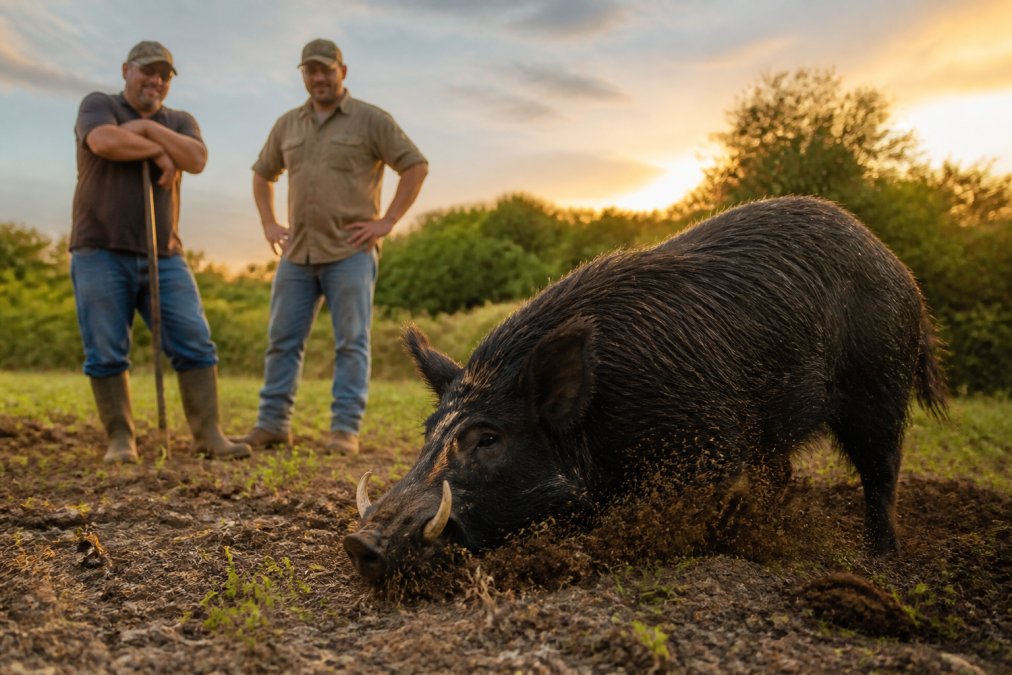
Why Wild Hogs Are America's Most Destructive Invasive Species
Wild hogs cause some of the most expensive wildlife damage of any invasive species in the country, and the problem keeps growing. According to the U.S. Department of Agriculture's feral swine damage resources, wild hog populations now exist across a majority of states, and the damage they cause each year runs into the billions. Unlike most invasive animals, hogs do not just compete with native wildlife, they reengineer the landscape.
The destruction takes several forms, and each one compounds the next:
- Habitat destruction: rooting tears up native vegetation and turns topsoil over like a rototiller, which strips food and cover from deer, turkey, and ground-nesting birds. Repeated rooting can convert a diverse understory into bare dirt and invasive weeds within a single season.
- Crop damage: fields of corn, peanuts, soybeans, rice, and cotton get plowed overnight. Hogs hit crops at the stage when sugar or starch content is highest, which is exactly when the yield loss is worst.
- Water quality: wallowing fouls streams and ponds, spreading sediment, nutrients, and bacteria. Hogs also defecate in and near water, which is one reason agencies treat them as a risk to both wildlife and livestock operations downstream.
- Property damage: fences, levees, irrigation lines, and golf courses all take hits. Rooting along levees and embankments is a genuine infrastructure concern, not just a cosmetic one.
- Disease and parasite transmission: hogs can carry and spread diseases that affect domestic swine and, in some cases, other wildlife. That overlap with commercial agriculture is why the issue gets attention far beyond hunting circles.
What most people miss is that wild hogs are not just a rural problem. Suburban edges, greenbelts, and even city parks increasingly see hog activity because the animals follow food and cover wherever it exists. A sounder that finds a subdivision with irrigated lawns and unsecured trash will keep coming back, and the damage escalates fast because the animals learn the pattern.
That is why wildlife management agencies treat them as a nuisance animal rather than a game species in many states. The distinction matters: a game species is managed for sustainable harvest, while a nuisance species is managed for removal. Hogs sit in the second category across most of their range because their populations grow faster than hunting pressure can suppress them.
Feral Pig Hunting Tips: Techniques That Actually Work
Feral pig hunting tips that actually work start with understanding how hogs use terrain. Wild hogs have poor eyesight but an excellent sense of smell, so the hunter who plays the wind correctly wins more often than the hunter who simply shoots straight.
A common mistake is treating hogs like deer. They are not crepuscular in the same predictable way, and they will move at any hour when pressure is low. Hunters who scout sign, fresh rooting, tracks, and wallows, and then set up downwind of it, consistently fill more tags than those who sit the same stand every weekend.
Stalking vs. Stand Hunting: Which Approach Fits Your Terrain
Stalking suits broken country with thick cover, creek bottoms, and rolling timber where you can move quietly and use terrain to mask your approach. Stand hunting suits open fields, agricultural edges, and feeders where hogs pattern predictably and you can watch multiple travel routes at once.
Wild Hog Hunting Gear: What You Need in the Field
Wild hog hunting gear comes down to three priorities: scent control, quiet movement, and a rifle or bow you can shoot fast in tight cover. Hogs have a nose that will bust you from a hundred yards, so anything that reduces your scent signature is worth the weight.
The essentials most experienced hunters carry:
- A centerfire rifle in .308.30-06, or 6.5 Creedmoor for open country
- A lever gun or AR platform for thick brush where shots come fast
- A quality headlamp with a red filter for night hunting
- A sharp knife and game bags for field dressing
- Breathable layers that let you move without rustling
What most gear guides skip is that your clothing matters as much as your rifle. Hogs key on movement and unnatural sound, so quiet fabric and a good layering system beat a heavier caliber you cannot shoot well. American Predator Gear builds apparel designed by hunters for hunters, including the Camo Long Sleeve quarter-zip, a moisture-wicking layer that keeps you quiet and comfortable on long sits.

Quality Deer Management Association's wild pig resource page
Best Time of Day to Hunt Hogs: Timing Your Hunt Right
The best time of day to hunt hogs is the first two hours after sunrise and the last two hours before dark, but hogs will move at night when hunting pressure pushes them there. On pressured public land, the middle of the day often produces better than dawn because the hogs have learned to move when everyone else has gone home.
Weather shifts the pattern too. Hogs move hard ahead of a front and right after rain, and they will feed through the middle of the day during cold snaps. The hunters who tag consistently are the ones who watch conditions rather than the clock.
Wild Hog Management and Control: What Hunters Should Know
Wild hog management and control works best when hunters, landowners, and wildlife agencies coordinate instead of acting alone. The uncomfortable truth that most hunting content skips is this: recreational hunting alone cannot suppress a wild hog population. Hogs breed too fast, and shooting one at a time removes animals more slowly than the population replaces them. Control requires removing whole groups at once.
That is why the professionals lean on a combination of tools:
- Trapping: corral traps and box traps that catch an entire sounder in one event. This is the single most effective removal method because it takes out the breeding core, not just the individuals that happen to cross a hunter's path.
- Aerial gunning: used by agencies and contractors in open country where hogs can be located and removed efficiently. It is not a recreational method, but it is a major part of large-scale control.
- Night hunting and thermal optics: legal in many states specifically because hogs are nocturnal under pressure. Thermal and night-vision gear lets hunters work the hours when hogs actually move.
- Hunting pressure: useful as a supplement. It keeps survivors mobile, wary, and harder for them to settle into a predictable pattern, which supports trapping and other removal efforts.
- Exclusion and fencing: expensive and rarely practical at landscape scale, but used around high-value crops and sensitive habitat.
State wildlife agencies set the rules on seasons, bag limits, licensing, and whether hogs can be taken year-round, and those rules vary widely. Some states treat hogs as a regulated game species with seasons and limits. Others classify them as a nuisance animal with no closed season and no bag limit, sometimes allowing night hunting or hunting over bait. A few states require a specific feral swine permit or landowner permission. Check your state agency's regulations before you hunt, because treating a nuisance animal like a regulated game species, or the reverse, can land you in real trouble.
Hunters play a genuine role in population control. Every hog removed is one less rooting up a field or fouling a creek, and that is a story worth wearing. American Predator Gear's Squeal Team Six and Oinkin From The Boinkin designs speak directly to the hog hunters who put in the work, and the Hunting License tee celebrates the tradition behind it.

Frequently Asked Questions
What is the difference between a wild hog and a feral pig?
A feral pig is a domesticated pig that has returned to the wild, while a wild boar is a true wild species native to Eurasia. In the United States, most wild hogs are hybrids, carrying genetics from both feral pigs and wild boars. This mixing makes them adaptable, smart, and difficult to manage. For hunters, the distinction matters less than understanding their behavior: both types are nocturnal, wary, and highly responsive to pressure.
Are wild hogs considered an invasive species?
Yes. Wild hogs are classified as an invasive species across most of the United States. They damage crops, destroy habitat, and compete with native wildlife for food. Their rooting behavior tears up fields and forests, and they can carry diseases that affect livestock and humans. State wildlife agencies actively encourage hunting as a population control tool, and many areas have year-round seasons with no bag limits to help reduce their numbers.
What gear is essential for a successful wild hog hunt?
Start with a reliable rifle or bow capable of ethical kills, then add scent control clothing and sturdy boots for varied terrain. Because hogs have poor eyesight but excellent smell, scent elimination is critical. A good headlamp or green light is essential for nighttime hunting. Many hunters also carry a knife for field dressing and a game cart for hauling. Layering with moisture-wicking base layers keeps you comfortable during long sits or stalks.
What are the best techniques for hunting wild hogs?
Trail cameras help you pattern hog movement before the hunt. Stand hunting over bait works well in areas with dense cover, while spot-and-stalk suits open terrain. Calling can bring in hogs during the rut. Because hogs are nocturnal, hunting at dawn and dusk increases your odds. Always play the wind and approach quietly. Many hunters find success by targeting water sources and feeding areas, especially during hot or dry conditions.
Wild hogs are here to stay, and the hunters who understand them, their habits, their damage, and the rules that govern them, are the ones who make a real difference in the field. American Predator Gear exists for that crowd: apparel designed by hunters for hunters, with limited-edition designs released every month that celebrate the grit, humor, and tradition of the outdoor lifestyle. Shop the collection and wear the story you live every season.